Erbil Governorate and Kurdistan Governorate Sign Memorandum of Understanding
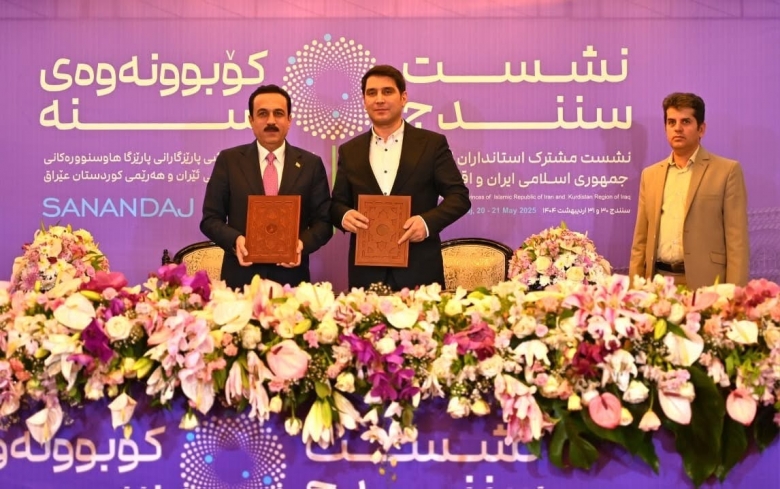
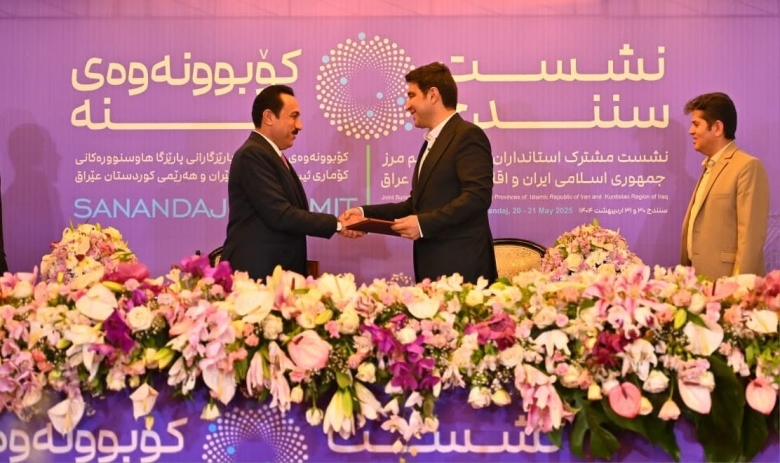
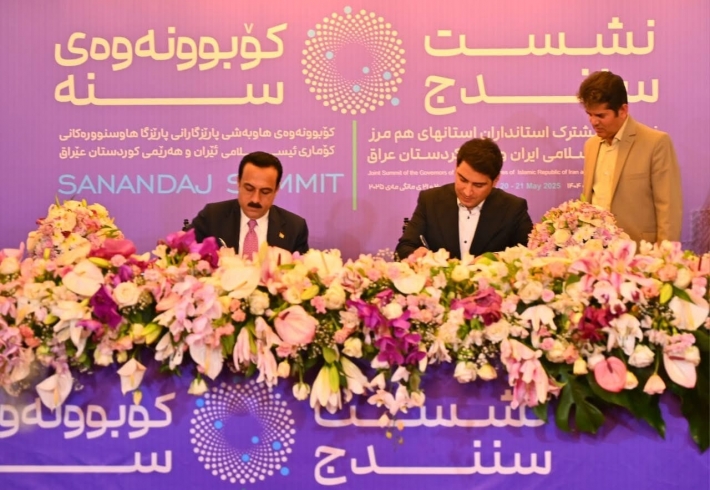
On Wednesday, May 21, 2025, within the framework of the third joint meeting of the border provinces of the Kurdistan Region and the Islamic Republic of Iran, Omed Khoshnaw, Governor of Erbil, and Arash Zarehtan Lahoni, Governor of Kurdistan, signed this Memorandum of Understanding. The aim is to strengthen and expand relations between Kurdistan Province of the Islamic Republic of Iran and Erbil, the capital of the Kurdistan Region, across three areas: economic, cultural-social, and scientific-technological. The MoU also aims to better utilize capacities and capabilities to raise the level of relations, achieve economic gain, and enhance the well-being of the people in the region. They agreed on the following points:
Point One: Economic Axis: Development of Border Cooperation and Constructive Development of Infrastructure
1.1 Trade and Customs Facilitation:
* Establishing a joint committee from the Chambers of Commerce to resolve legal disputes and disputes regarding agreements between businessmen and bilateral economic operators.
* Cooperation between relevant customs authorities and border forces with the aim of exchanging experience, facilitating legal trade, and resolving issues related to citizens' residency.
* Cooperation between relevant customs authorities and border forces with the aim of exchanging experience, facilitating legal trade, and resolving issues related to citizens' residency.
* Providing the basis conditions for the direct transfer of exported goods, including those with expiration priority and those that spoil quickly, as well as agricultural products, via a bilateral transport system or through joint international transport companies.
* Avoiding sudden and unplanned restrictions on the transportation of goods and providing immediate notification via the joint secretariat.
1.2 Joint Investment:
* Encouraging and attracting capable and qualified investors for joint investment.
* Holding conferences on joint investment opportunities.
1.3 Infrastructure, Transport, and Technical and Engineering Services:
* Facilitating the exchange of technical and engineering services and cooperation in construction projects, infrastructure development, and the development of transport routes.
1.4 Health Economy:
* Providing specialized and sub-specialized medical services to patients from the Kurdistan Region in the medical centers of Kurdistan Province (including sub-specialized surgery, gynecology and obstetrics, oncology, cosmetic surgery, dentistry, etc.).
* Promoting and strengthening health tourism, developing health ecotourism, and organizing the informal health tourism market in order to protect the rights of those receiving medical services
Point Two: Cultural - Social - Environmental Axis: Strengthening Common Identity and Cultural Cooperation
2.1 Cultural Heritage and Tourism:
* Holding joint events, including festivals, tourism familiarization trips, and specialized conferences and exhibitions in the field of tourism and handicrafts.
* Creating the conditions for expanding cooperation between tourism companies with the aim of developing tourism and implementing joint tours.
* Planning awareness and marketing trips for health tourism companies and activists to visit hospitals licensed to receive international patients (IPD), as well as tourist sites (ecotourism), with an emphasis on health tourism.
* Facilitating the movement of tourists and pilgrims via the border through simplified permits.
* Reviving common pilgrimage and historical routes for visiting religious and historical sites and developing tourism infrastructure.
2.2 Culture and Art:
* Laying the groundwork for the biennial holding of Kurdish Art Week (film, theater, music festivals, etc.).
* Efforts to define and establish a literary-artistic award and hold joint exhibitions of books and artistic works.
* Efforts to create a digital archive and a joint database of local Kurdish literature, music, and melodies with the cooperation of universities, literary institutions, organizations, and artists from both sides.
2.3 Fields of Work and Social Welfare:
* Efforts to conclude an agreement in the field of labor exchange and legal protection for the workforce of both parties.
* Establishing centers for vocational counseling and job search with the aim of facilitating the conditions for sending labor from both sides.
* Cooperation in developing skill training standards and learning resources and localizing them in the four sectors of industry, services, agriculture, and culture/art, and establishing joint technical and vocational centers.
2.4 Environment and Natural Resources:
* Developing cooperation to find ways to protect forests, environmental resources, and benefits, and address common environmental challenges.
* Exchanging environmental experiences and training to improve the resolution of environmental challenges facing both sides.
Point Three: Higher Education, Innovation, and Technology
* Strengthening bilateral cooperation between the universities of both sides, particularly in new scientific fields such as artificial intelligence.
* Expanding cooperation in the exchange of teachers and students between the universities of the two sides.
* Holding joint scientific and cultural conferences and events between the universities of both sides.
* Efforts to launch an online education platform (virtual university) by offering joint courses.
* Establishing joint UNESCO research chairs.
* Defining and implementing joint research projects on common challenges such as water crisis and drought, dust, food security, etc., as well as providing 6-month study opportunities for researchers at the universities and research centers of both parties.
* The universities of the Kurdistan Region and Kurdistan University shall endeavor to unify and standardize the Kurdish language across all dialects digitally.
* Cooperation in developing skill training standards and training course resources, and conducting training courses for the skill trainers needed for the Kurdistan Region of Iraq, at Iran's technical and vocational training centers.
* Cooperation for the development of the digital economy and the introduction of the parties' capabilities and businesses in the field of technology.
* Assistance in investment in technology units and knowledge-based companies, and technology/technology market facilitation for exporting the products and services of knowledge-based companies.
Point Four: Follow-up and Implementation
* Both governors shall remain in continuous contact for the implementation of the points and clauses of this Memorandum of Understanding, in coordination with the Consulate General of the Islamic Republic of Iran in Erbil and the foreign relations body of the Kurdistan Region of Iraq.