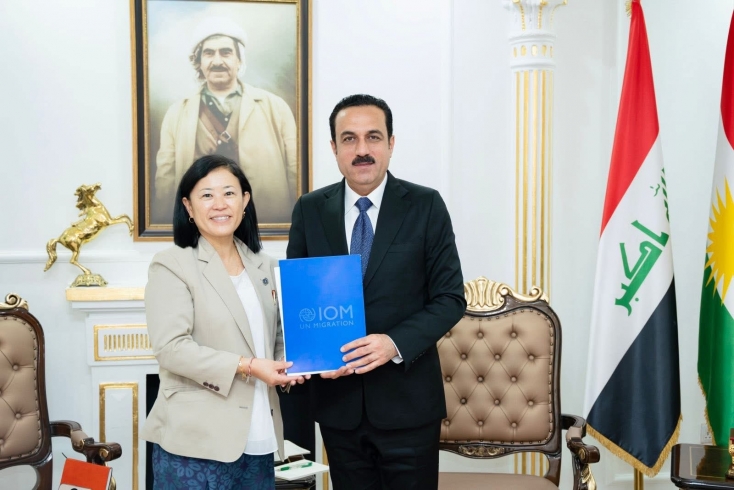
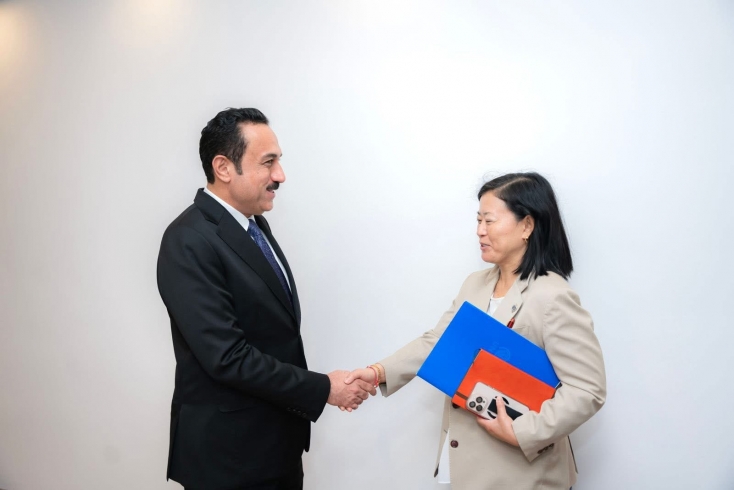
The Governor of Erbil... With the Head of the International Organization for Migration (IOM), greater coordination was emphasized
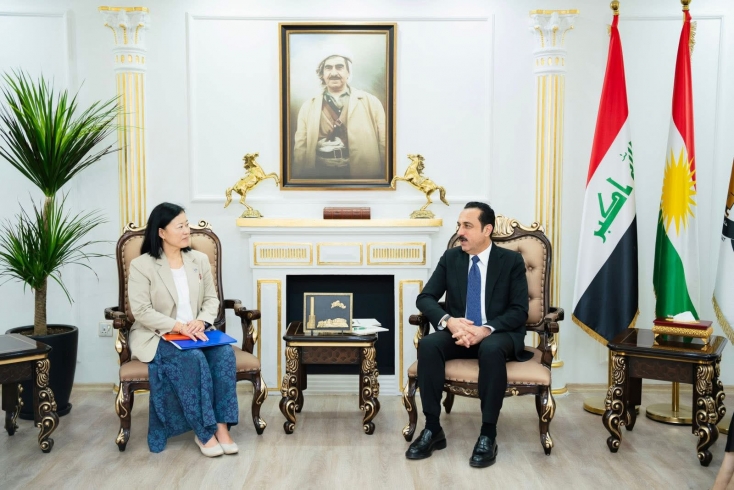
On Wednesday, August 20, 2025, Omed Khoshnaw, the Governor of Erbil, at the Governorate Office, in the presence of Naz Jalal, Director of the Erbil Joint Crisis Coordination Center (EJCC), welcomed Dr. Yugo Fujimura, the Head of the International Organization for Migration (IOM).
During the meeting, the Head of the International Organization for Migration thanked the Governor of Erbil for his time and presented a brief on the projects, work, and activities of the IOM. She mentioned that in the new season of their work, they have implemented 44 projects, and from 2019 until now, they have implemented 190 projects in Iraq. Currently, they are busy with a school renovation project in Daratu.
She also discussed bringing document examination equipment, as well as devices that assist in crime detection, in addition to bringing a special database machine for information on countries' passports and the changes that occur in that regard.
Yugo Fujimura reiterated that they are working intensively on the establishment of the labor draft law and are in contact with the relevant authorities of the regional government to establish this project. Regarding the displaced, She reaffirmed their support, stating that they support this issue as a group. She also spoke with emphasis on the importance of protecting the climate, which is a matter of interest to the international community.
For his part, the Governor of Erbil, while welcoming the guest delegation, emphasized the value and importance of the work and activities of the International Organization for Migration (IOM).
The Governor of Erbil elaborated in detail on the issue of the displaced, pointing out that the Kurdistan Region is a rare example compared to other countries because, at the same time, we have both Kurdish refugees and have received a large number of refugees in the Kurdistan Region. Now, unfortunately, after the central government cut their aid, the regional government's policy has offered them voluntary return and does not want these displaced people to become part of a political game. Therefore, it is necessary for the UN agencies to provide logistical and practical support.
Regarding the climate project that the IOM is working on in Qushtapa, the Governor of Erbil emphasized that in the ninth cabinet of the Kurdistan Regional Government, there is comprehensive planning for the effects and consequences of climate change. From this perspective, they have taken good practical steps. For example, in the matter of the lighting project, a large number of generators that had a direct negative impact on the climate have been turned off, and the signs of this are now visible in the city's sky, showing a difference from before. It has also been decided that by the end of the year, electricity for all cities and towns in the Kurdistan Region will become 24-hour, which will have a direct reflection on the cleanliness of the air and climate.
During his discussion with Yugo Fujimura, the Head of the International Organization for Migration, the Governor of Erbil pointed to the Erbil Emergency Water Project, stating that because of this project, Erbil will not have a water problem for another 30 years. This has been the strongest and fastest strategic project in the region. The process of sourcing water for the project begins from the Great Zab River, and the cleaning, purification, filtering, and chlorination of the water is implemented according to the standards of the World Health Organization (WHO) and Iraq.
He also mentioned the Qushtapa water project, which is sourced from the Little Zab River. Besides Qushtapa itself, 72 surrounding villages will also benefit from this project.
The Governor of Erbil also pointed to the creation of ponds to strengthen the strategy of benefiting from and collecting rainwater, giving examples such as the ponds of Chamerga, Komaspan, Bastora, and Aquban.
He also spoke about the green belt of Erbil city, a strategic project with a width of 2 kilometers and a length of 70 kilometers, which will be of immense benefit for environmental cleanliness, encircling the capital city of Erbil in a circular fashion. All of these are reflected in the implementation of the Erbil Master Plan.
In the end, both sides agreed that a large part of the aforementioned organization's projects should be dedicated to the development of the capital city of Erbil, and both sides reaffirmed greater coordination between them.